The Black Pottery of Marginea: A Timeless Romanian Craft
In the village of Marginea, potters still shape and fire clay into glossy black vessels using a technique passed down through generations.
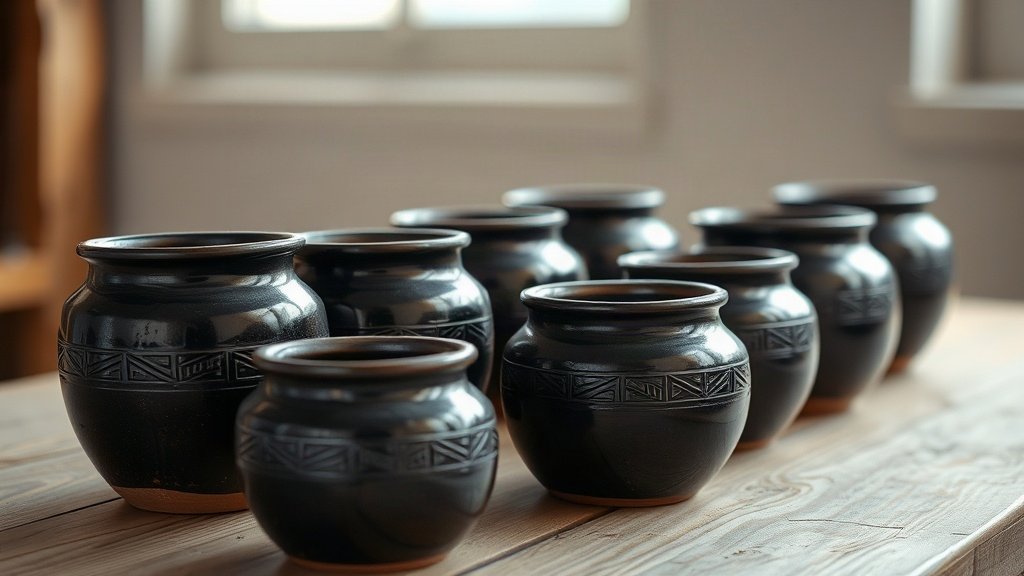
Illustration: AI-generated image
In the rolling hills of Bukovina, near the town of Rădăuți, lies the village of Marginea — a place whose name has become synonymous with one of Romania's most distinctive ceramic traditions. Here, for at least three centuries, potters have produced black pottery, a kind of earthenware known for its deep, smoky colour and subtle sheen. Unlike the brightly painted Horezu ware or the blue-and-white Corund ceramics, Marginea pottery is entirely unglazed, relying on a special firing process to achieve its signature dark finish.
A technique rooted in fire and earth
The defining feature of Marginea black pottery is the firing method. Potters use a traditional wood-burning kiln, often built into the ground or as a simple brick chamber. Once the shaped and dried vessels are loaded inside, the kiln is sealed, and the fire is suffocated — a process known as reduction firing. With little oxygen available, the clay's iron content turns black rather than red, and the smoke permeates the surface, creating a natural, durable finish that needs no glaze.
Before firing, each piece is carefully burnished with a smooth stone or bone while the clay is still leather-hard. This polishing compresses the surface and gives the finished pot a soft, metallic lustre. Decoration, when present, is typically simple: incised lines, dots, or geometric motifs — spirals, waves, and sun symbols — inspired by older peasant art. The result is elegant in its restraint, with the deep black background allowing the subtle incisions to catch the light.
From the potter's wheel to the hearth
Marginea potters have long created functional objects for everyday rural life. Traditional forms include tall water jugs, round cooking pots, bowls, plates, and cups. Many families in the region once used such vessels for storing milk, fermenting cabbage, or baking bread in wood-fired ovens. The black pottery's porous yet sturdy nature made it ideal for keeping food cool and fresh. Today, many of these same shapes are still made, though they now often serve as decorative pieces or souvenirs for visitors exploring northern Romania.
The craft is usually passed down within families, from parent to child, with knowledge shared through hands-on practice rather than written instruction. While some potters now use an electric wheel for shaping, the essential steps — burnishing, decorating, and reduction firing — remain largely unchanged. This continuity is part of what makes Marginea pottery so valued: it is a living link to a pre-industrial way of making things, where the rhythm of work follows the seasons and the availability of local clay.
A symbol of Bukovina's cultural heritage
Black pottery is not unique to Marginea; similar techniques exist in other parts of Romania and across the Balkans. Yet Marginea has become a recognised centre for this craft, with the village's potters maintaining a reputation for exceptionally fine, thin-walled vessels. The pottery is often featured at folk fairs and ethnographic museums, and it attracts collectors interested in authentic Romanian folk art.
For visitors, watching a Marginea potter at work is a memorable experience. The process is slow and meditative: the soft whir of the wheel, the careful burnishing, the dramatic moment when the kiln is opened to reveal rows of charcoal-black pots. It is a reminder that craftsmanship is not just about the final object, but about the relationship between maker, material, and tradition.
Although the number of active potters in Marginea has decreased over the decades, the craft endures. Efforts by cultural organisations and the potters themselves to pass on skills to younger generations have helped keep the tradition alive. In an age of mass production, the black pottery of Marginea stands as a quiet, beautiful example of what can be achieved with patience, skill, and fire.