Romania's Painted Easter Eggs: A Traveler's Guide to a Living Tradition
Discover the intricate art of Romanian Easter eggs, a centuries-old craft practised with wax and natural dyes, and learn where to see these miniature masterpieces for yourself.
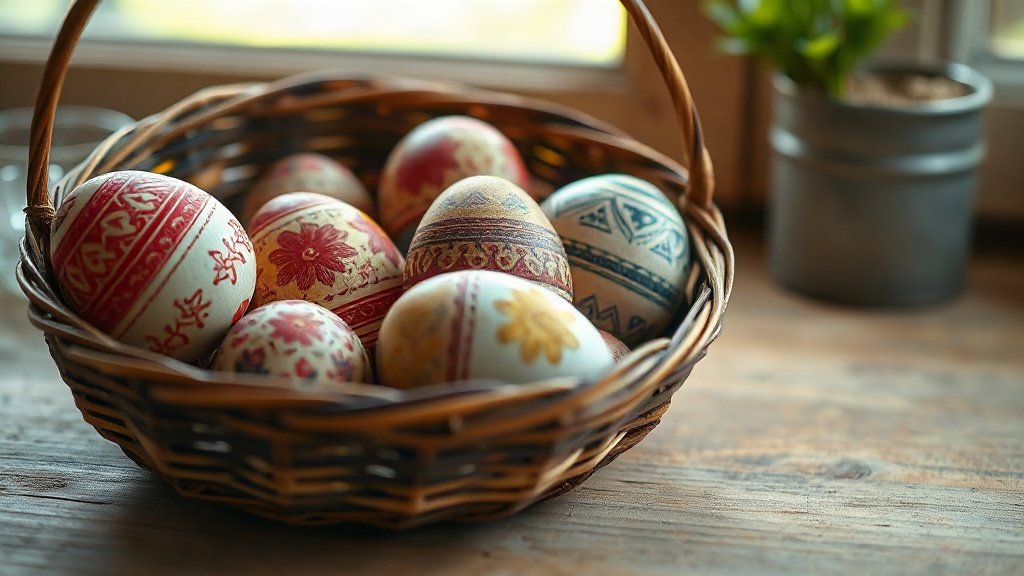
Illustration: AI-generated image
In the days before Easter, homes across Romania fill with the faint smell of beeswax and the quiet scratch of a stylus on shell. Painted eggs—known as ouă încondeiate—are more than seasonal decoration; they are a living folk art passed down through generations, with patterns that speak of fertility, protection, and the return of spring. For travellers, learning about this tradition offers a window into rural life that persists year-round, even outside the Easter season.
The craft: wax, dye, and patience
The most widespread technique uses a wax-resist method. A small wooden or metal tool called a chișiță is dipped in melted beeswax, then drawn across the eggshell in fine lines. The egg is then immersed in natural dyes—yellow from onion skins, red from madder root, green from walnut leaves, and black from oak bark. After each colour, more wax is applied to preserve that shade, building up intricate layers. Finally, the wax is melted off to reveal a multicoloured design of geometric motifs, leaves, crosses, and spirals.
In some regions, especially around the village of Ciocănești in Bucovina, a second method known as încondeiere cu acid (acid etching) is used. The egg is first dyed a single dark colour, then a sharp instrument scratches away the surface to create a delicate negative pattern. The result is a monochrome egg with astonishing detail.
Where to see the eggs
The most comprehensive collection is at the Museum of Painted Eggs in Ciocănești, a village in Suceava County that itself is a UNESCO-listed museum of painted houses. The museum displays hundreds of eggs from different regions, along with the tools and dyes used. Many of the village's artisans also welcome visitors into their homes to demonstrate the craft, though it is polite to ask or arrange in advance.
Elsewhere, the Village Museums in Bucharest, Sibiu, and Cluj-Napoca hold excellent examples of decorated eggs in their ethnographic collections, often shown within traditional house interiors. During the weeks leading up to Orthodox Easter, open-air fairs and markets in towns like Brașov, Sibiu, and Timișoara feature live demonstrations and rows of finished eggs for sale.
Taking part: workshops and souvenirs
Many guesthouses in rural areas, particularly in Bucovina and Maramureș, offer short workshops where visitors can try the wax-resist technique under the guidance of a local artisan. These sessions are suitable for all ages and require no prior artistic skill—only a steady hand and willingness to let the wax flow unpredictably. The eggs you decorate become unique, fragile souvenirs.
When buying eggs, look for ones made using traditional natural dyes and beeswax; they should feel smooth and cool, with a faint waxy sheen. Prices vary widely but are generally modest, and purchasing directly from the maker ensures the craft continues to support local families.
Planning your visit
While Easter is the most atmospheric time to see the tradition in full swing, museums and workshops operate throughout the year. To see eggs being made in a home setting, contact a local guide or cultural association in Bucovina or the Rădăuți area. Combine a visit to the painted monasteries with a stop in Ciocănești to appreciate the same decorative impulse applied to both architecture and eggshells. The tradition is a reminder that in Romania, art is not confined to galleries—it is held in the palm of a hand, ready to be cracked open at the breakfast table come Easter morning.