Cobza: Romania's Short-Necked Lute and Its Revival
The cobza is a traditional Romanian string instrument with a rich, resonant sound. Learn about its history, construction, playing style, and place in folk music.
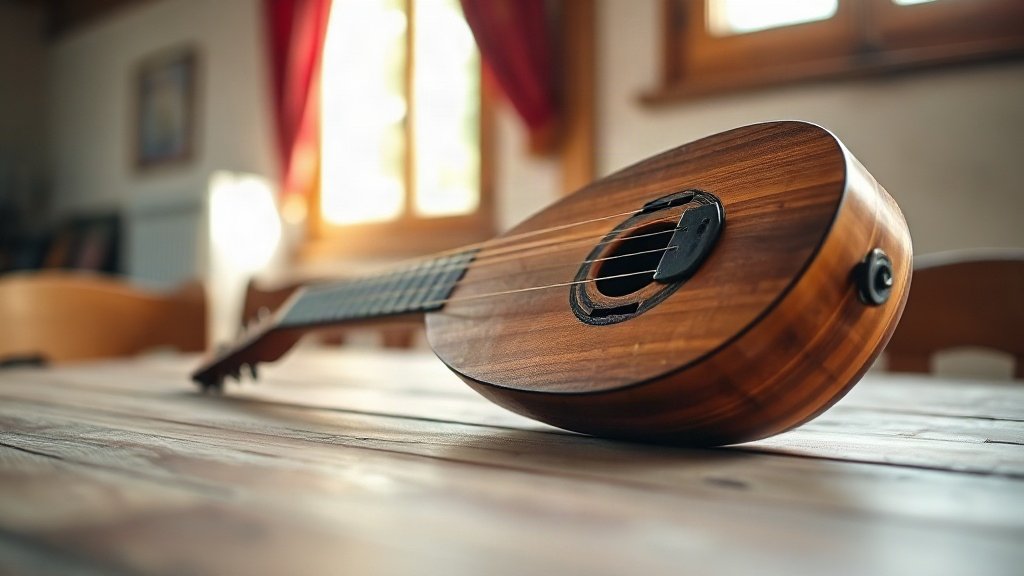
Illustration: AI-generated image
The cobza is a traditional Romanian plucked string instrument that has accompanied folk music for centuries. With its rounded back, short neck, and warm, resonant tone, the cobza occupies a special place in the country's musical heritage. It was once a staple of lăutari ensembles—professional folk musicians—and is now experiencing a quiet revival among enthusiasts and performers.
What is a cobza?
A cobza is a type of short-necked lute, similar in shape to the oud or the mandolin but distinct in its construction and sound. It typically has a pear-shaped body with a deep, rounded back made from strips of wood, a flat soundboard, and a relatively short, fretted neck. The strings, usually four or five courses, are plucked with a plectrum made from a feather, plastic, or horn, producing a bright yet mellow tone that carries well in both solo and ensemble settings.
History and regional roots
The cobza has ancient origins, with connections to lutes played across the Balkans and the Middle East. In Romania, it became particularly popular in the regions of Wallachia and Moldavia from the 17th century onward. It was a common instrument in urban and rural folk music alike, often played by lăutari for dances, weddings, and celebrations. By the mid-20th century, however, the cobza began to decline as other instruments such as the accordion and the cimbalom gained favour. For a time, it was at risk of fading from the folk music scene.
Construction and sound
Traditional cobzas are handcrafted by skilled luthiers using woods such as spruce, maple, and walnut. The body is assembled from numerous thin strips glued together to form the bowl, while the soundboard is often left plain or decorated with a simple rosette. The strings are tuned in unison pairs, giving the instrument a fuller, chorus-like effect. Players use a plectrum to strum chords or pick melodies, often employing rapid rhythmic patterns that drive the dance tunes of the region. The cobza's sound is sometimes described as a blend of the guitar and the mandolin, but with a distinctly earthy and intimate quality.
Role in folk music
In traditional ensembles, the cobza often provides harmonic and rhythmic accompaniment, supporting the melodic lines of violins, flutes, or the nai. It is especially well-suited for accompanying dances such as the sârba, hora, and brâul, where its percussive strumming helps maintain a lively tempo. In slower doinas and ballads, the cobza can deliver gentle arpeggios that underpin the vocalist's emotional delivery. Its versatility made it a favourite among lăutari, who valued both its volume and its ability to blend with other instruments.
A quiet revival
In recent decades, there has been a renewed interest in the cobza among folk music enthusiasts and professional musicians. Workshops, festivals, and recordings featuring the instrument have helped introduce it to new audiences. The cobza's unique voice adds an authentic touch to both traditional and contemporary folk arrangements, and its revival is a testament to the enduring appeal of Romania's rich musical legacy. For anyone curious about the sounds of old Romania, the cobza offers a captivating entry point.