The Romanian Ia: A Blouse Woven with Symbols and Stories
The ia is more than a traditional shirt – it is a canvas of Romanian identity, embroidered with ancient symbols and regional patterns that have inspired artists and designers for centuries.
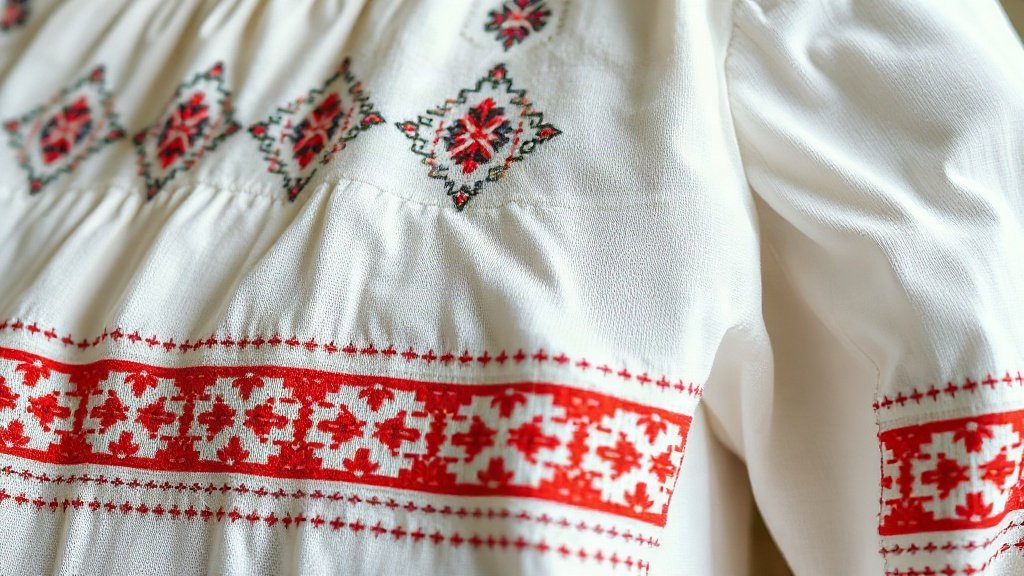
Illustration: AI-generated image
The roots of the ia
The ia (pronounced ee-ah) is the emblematic blouse of the Romanian peasant costume, worn by women for centuries across the country’s historic regions. Made from homespun linen, cotton or hemp, it is gathered at the neck with a drawstring and falls loosely over the body, its wide sleeves often ending in elaborate cuffs. But what truly sets the ia apart is its embroidery – dense, colourful and deeply symbolic.
The garment likely evolved from the ancient tunic worn in the wider Balkan and Eastern European region, but over time Romanian artisans developed a distinctive style. The oldest surviving examples date from the 19th century, although the motifs they carry are far older, rooted in pre-Christian beliefs and cosmic imagery.
Symbols stitched in thread
Every stitch on an ia has meaning. The embroidery is usually concentrated on the chest, sleeves and shoulders – areas believed to protect the wearer from evil spirits. Common motifs include the sun, stars, spirals, the tree of life, and the rhombus. The rhombus, often with hooks at the corners, represents a sown field and female fertility. The spiral symbolises time, eternity and the journey of the soul. Colours also matter: red stands for life and blood, black for the earth, yellow for the sun, blue for the sky.
The placement of these symbols follows a strict logic. The sleeve embroidery, known as altiță, runs vertically from the shoulder to the elbow and often features geometric bands. The chest panel, or piept, may show a stylised tree or a pair of birds. These designs were never random; they were passed down from mother to daughter, keeping regional identity intact.
Regional styles across Romania
While the basic cut is similar, each ethnographic zone has its own take on the ia. In Maramureș, the blouses often feature dense, geometric patterns in black and red. In Oltenia, the embroidery is lighter and more floral, with delicate stems and leaves. In Bucovina, the sleeves are covered with rows of tiny motifs in bright colours, and in Transylvania, the ia may be paired with a richly decorated apron. The region of Bihor is particularly famous for its intricate, almost lace-like stitching. In 2022, the traditional blouse with embroidery on the shoulder (altiță) was inscribed by UNESCO on the Representative List of the Intangible Cultural Heritage of Humanity, recognising its importance to Romanian and Moldovan identity.
Men also have a version, though simpler: a long shirt, often with embroidery on the chest and cuffs, worn over trousers.
The ia in modern Romania and beyond
In the 20th century, the ia caught the eye of artists and designers far beyond Romania. Henri Matisse painted several works featuring women in Romanian blouses, most famously “La Blouse Roumaine” (1940). In the 1960s, Yves Saint Laurent incorporated elements of the ia into his haute couture collections, and since then the blouse has appeared on international runways and in museum exhibitions. In Romania itself, the ia never truly went out of fashion; it is worn at weddings, folk festivals and national celebrations, and has become a symbol of pride for the Romanian diaspora.
Today, contemporary Romanian designers reimagine the ia, using modern fabrics while preserving the traditional symbols and hand-embroidery techniques. The result is a garment that bridges past and present, carrying the stories of rural life into the 21st century.