Șezătoarea: Romania's Traditional Spinning Bee of Song and Story
Discover the șezătoare, a cherished Romanian winter gathering where women spin, embroider, sing, and share stories by the fire.
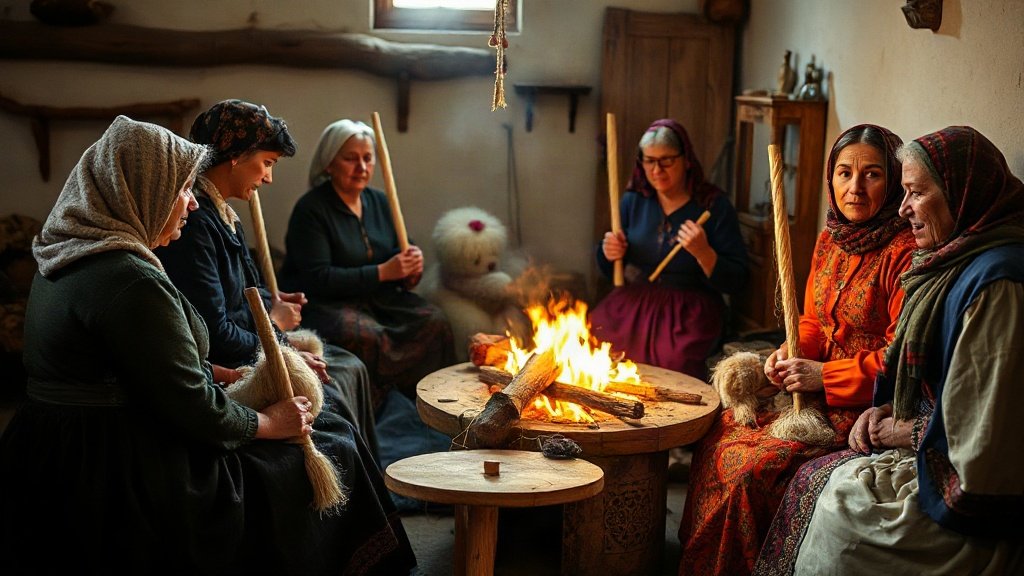
Illustration: AI-generated image
On long winter evenings in rural Romania, the flicker of a fire and the gentle hum of a spinning wheel once marked the start of a cherished tradition: the șezătoare. More than a simple work session, this gathering of women and girls was a vibrant social ritual where craft, song, and story wove the fabric of community life.
What is a șezătoare?
The word șezătoare derives from the Romanian verb a ședea, meaning 'to sit'. True to its name, it was an evening where women sat together to spin wool, embroider, weave, or sew. Held primarily during the winter months, when outdoor work slowed, a șezătoare took place in someone's home, rotating among neighbours. The hostess would prepare the room, often around a central fire or stove, and each woman brought her own tools and materials. While hands worked, conversation flowed: news was exchanged, jokes were told, and laughter filled the air.
The primary activity was spinning wool. Women used a fus (spindle) or a roată de tors (spinning wheel) to turn raw wool into yarn. Others embroidered traditional motifs on ie (blouses), ștergare (towels), or fețe de pernă (pillowcases). The repetitive motions were rhythmic and meditative, allowing for easy conversation and song.
Typically, the gathering began after the evening meal and could last until midnight. Girls as young as ten or twelve joined their mothers and grandmothers, learning skills and customs through participation. The atmosphere was informal yet purposeful—work was done, but the social dimension was equally important.
Song, story, and social glue
The șezătoare was as much a cultural salon as a workshop. Women sang doinas (lyrical songs), ballads, and sometimes colinde (carols) if the gathering fell near Christmas. Storytelling was central: fairy tales featuring Făt-Frumos and Ileana Cosânzeana, legends about local heroes, and riddles were shared aloud. These oral traditions were passed from generation to generation in exactly this setting, ensuring their survival long before they were written down.
Men were not always absent. On certain evenings, young men might join the group, especially towards the end of the gathering. Then the spinning would pause, and songs gave way to dances like the hora or brâul. Such mixed gatherings often played a role in courtship, as young people could meet in a supervised, community-approved environment.
Beyond entertainment, the șezătoare strengthened social bonds. It was a place to seek advice, share worries, and offer support. For women in traditional rural society, whose lives were largely confined to home and field, it provided a rare and valued space for female solidarity and collective expression.
A tradition that endures
With the modernisation of the countryside in the 20th century—rural electrification, factory-made textiles, and the migration of younger generations to cities—the traditional șezătoare declined. However, its spirit has not disappeared. Folklore ensembles, cultural associations, and village museums across Romania have revived the custom as a way to celebrate intangible heritage. In some regions, particularly in Maramureș and Bukovina, women still organise genuine șezători during winter, keeping the practice alive.
Today, the șezătoare is recognised not only as a method of textile production but as a vital social institution. It embodies values of cooperation, creativity, and community that resonate far beyond its original context. For visitors interested in Romanian folk culture, witnessing or participating in a modern șezătoare offers a rare glimpse into a living tradition that has shaped generations of rural life.