Ouă Încondeiate: Romania's Art of Decorated Easter Eggs
Discover the intricate craft of ouă încondeiate, Romania's traditional decorated eggs, and the symbolism woven into every line.
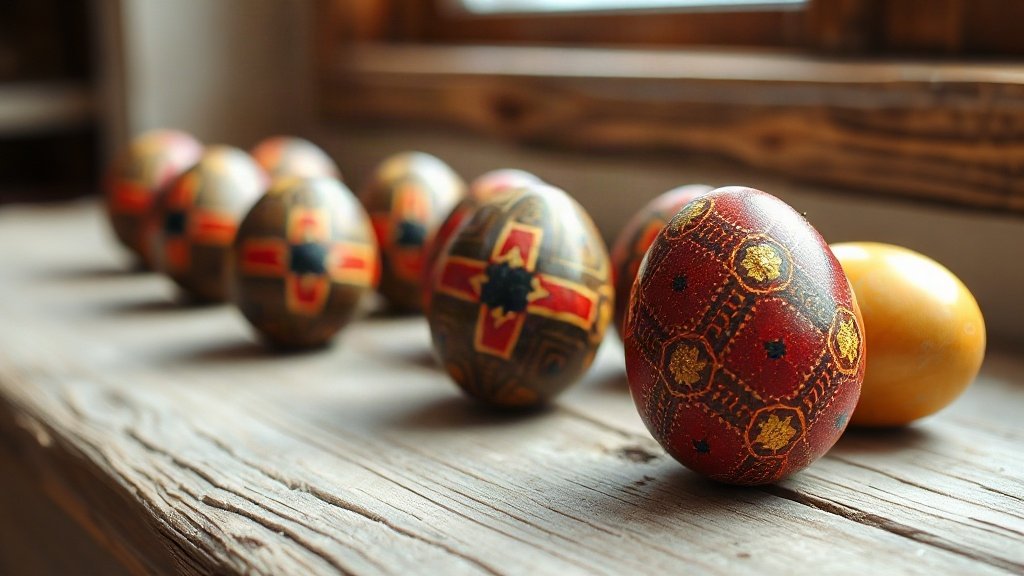
Illustration: AI-generated image
In Romania, the humble egg is transformed into a canvas of intricate patterns and vibrant colours. Ouă încondeiate—decorated eggs—are far more than festive ornaments; they are a living folk art with roots that stretch back to pre-Christian times. The egg, a universal symbol of life and rebirth, became central to spring rituals and, later, Easter celebrations. Each decorated egg carries wishes for health, luck, and renewal, its patterns a silent language of protection and good fortune.
The Art of Wax Resist
The most widespread technique for decorating eggs in Romania is wax resist, known as încondeierea cu ceară. A small wooden or metal tool called a condei—often with a tiny copper funnel at the tip—is dipped in melted beeswax. The artisan draws fine lines and dots of wax onto the eggshell, covering areas that will remain the base colour. The egg is then submerged in a natural dye bath, traditionally made from onion skins (for golden browns), red beetroot, walnut shells, or dried flowers. After dyeing, the wax is melted off to reveal the pattern, and the process is repeated with additional colours for more complex designs. A simpler method, zgârierea (etching), involves scratching patterns into a solid-coloured dyed egg with a sharp tool. Some regions also use leaf or flower pressings: plants are wrapped around the egg before boiling, leaving natural imprints.
Regional Motifs and Meanings
Every line and colour on an încondeiat egg has meaning. The sun, the most common motif, appears as a wheel, rosette, or continuous spiral. The cross symbolises faith, the wheat ear stands for good harvest, and the zigzag line represents water and life. Colours carry symbolism too: red for life and love, black for eternity, yellow for the sun's warmth, and green for nature. Bucovina is famous for its intricate geometric patterns in dark red, black, and yellow, often laid out in strict symmetry. In Vrancea and Maramureș, motifs are freer, with stylised leaves and crosses. The village of Ciocănești in Suceava county has become a hub of egg-decorating, with many homes painted in the same motifs as their eggs, and a dedicated museum that displays traditional and contemporary examples.
Where to See and Try It
Ouă încondeiate are most visible around Easter, when markets and fairs across Romania fill with baskets of colourful eggs. Ethnographic museums in Bucharest, Cluj-Napoca, and Sibiu often include decorated eggs in their collections, showing the evolution of the craft. For hands-on experience, workshops are occasionally offered by cultural centres and artisans, particularly in Bucovina. If you wish to try at home, begin with blown eggs—empty shells—and use a simple wax resist technique with a fine paintbrush or a needle. Natural dyes from onion skins and red cabbage are easy to prepare and give beautiful, earthy tones. Patience is essential: the best artisans spend hours on a single egg, letting the wax flow in a meditative rhythm that has been passed down through generations.
Ouă încondeiate are a testament to Romania's enduring connection to nature, craft, and the cycles of life. Each egg is a small, fragile world of meaning, waiting to be read by those who know the language of its lines.