Mărțișor: How Romania Welcomes Spring on the First of March
Every year on 1 March, Romanians exchange small red-and-white tokens to mark the start of spring. Here is the story behind the tradition and how to join in.
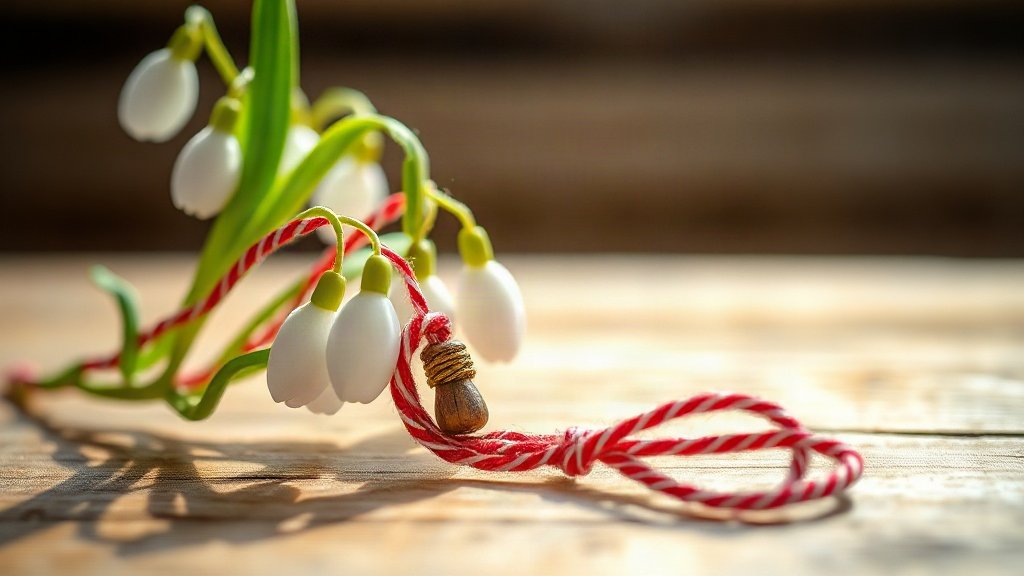
Illustration: AI-generated image
Walk through any Romanian town in the last days of February and you will notice something change. Stalls and shop counters fill with tiny red-and-white tassels, strings and trinkets. This is Mărțișor, one of the country's best-loved customs, and it marks the first day of March and the hope of spring.
What is Mărțișor?
The name refers both to the small object itself and to the tradition around it. The word comes from Martie, the Romanian for March. The token is traditionally a red and white twisted cord, often with a small charm attached, and it is given as a gift on 1 March.
The custom is also observed in neighbouring countries, notably Moldova, Bulgaria and North Macedonia, with local variations. In 2017 it was added to UNESCO's list of intangible cultural heritage as a shared tradition across several countries.
Why red and white?
The colours are usually explained symbolically. Red is linked with life, warmth and vitality, while white is linked with purity and the last of the winter snow. Together, the twisted thread stands for the turn of the seasons.
There are many folk stories about its origins, and none can be treated as definitive. What matters to most people is the meaning of the gesture: a small wish for health and good fortune in the months ahead.
How it is given and worn
Traditionally, men and boys give Mărțișor to women and girls, including friends, colleagues, relatives and teachers. It is often accompanied by a flower, commonly a snowdrop, tulip or hyacinth. Many families also give one to mothers and grandmothers.
The token is pinned to clothing near the heart, or worn on the wrist, for the first days of March, or sometimes through the month. An older custom holds that it should then be tied to a blossoming tree, as a wish for the year to come.
Taking part as a newcomer
- Keep it simple. A small cord or brooch with a flower is perfectly in keeping with the tradition.
- Give it widely. It is not a romantic gesture only. Offering one to colleagues, neighbours or your child's teacher is entirely normal.
- Look for handmade pieces. Craft fairs and local artisans often make their own versions, from beaded designs to ceramic and wooden charms.
- Make your own. Twisting red and white thread is an easy activity for children, and many Romanian schools do exactly this.
Why it endures
In a country with cold, long winters, the arrival of March is welcomed with real feeling. Mărțișor is a small, cheerful way to acknowledge that, and it asks very little of those who join in. For anyone settling in Romania, receiving one is a warm sign that you have been noticed and welcomed.
It is also a pleasant reminder that the customs which shape daily life here are often the quietest ones: a thread, a flower and a good wish passed from hand to hand.