Hora: Romania's Circle Dance of Unity and Celebration
Discover the Hora, Romania's most cherished folk dance, where hands are joined and a community moves together in a living circle of music and tradition.
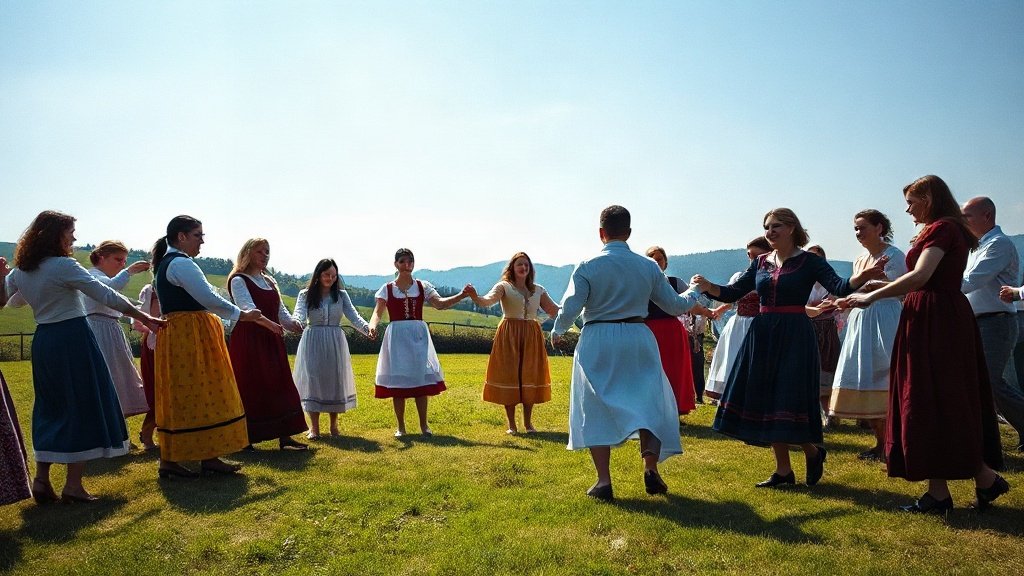
Illustration: AI-generated image
When the music strikes up at a Romanian wedding, festival, or village gathering, it rarely takes long for a circle to form. Hands are linked, shoulders sway, and soon the whole crowd is moving as one in the hora. More than just a dance, the hora is a symbol of community, continuity, and shared joy that has been part of life in these lands for centuries.
The hora is a closed circle dance, typical of the Balkans and the Carpathian region. Its name comes from the Greek word choros, meaning dance, and it has deep roots in ancient ring dances that celebrated the cycles of life, harvest, and union. In Romania, the hora is the national dance, performed at everything from intimate family celebrations to major public holidays.
The Shape of Togetherness
At its heart, the hora is refreshingly simple: dancers hold hands or link arms and step to the side in a rhythmic pattern. The circle can grow or shrink, but it never breaks. There is no lead couple, no exclusive pairs—everyone is equal, facing inward, connected by touch and movement. This physical link is the essence of the hora: a visible expression of belonging.
The tempo and style vary by region. The Hora Mare, or Great Hora, of Moldavia and Oltenia is a slow, dignified dance often performed at weddings, with dancers taking small, measured steps. The Hora de mână, or hand hora, is faster and more playful, with quick footwork and occasional twirls. In Banat and Transylvania, the hora may be danced in a line or a spiral, but the principle remains the same.
How to Join In
If you find yourself at a Romanian celebration and a hora begins, do not hesitate to step into the circle. The basic step is easy: step to the left with your left foot, cross your right foot behind, step left again, and then bring your right foot to meet the left. Then repeat. The rhythm is steady, and you will quickly pick up the flow by following the person next to you.
The most important rule is to keep the circle intact. Do not pull, push, or let go of your neighbours’ hands unless you are leaving the dance. Smile, enjoy the music, and let the collective energy carry you. You do not need to know the fancy variations—the hora is for everyone, from children to grandparents.
A Dance for All Occasions
The hora appears at nearly every important life event in Romania: weddings, baptisms, national holidays, and even after church on Sundays in some villages. It is also danced at community gatherings and cultural festivals, where it serves as a bridge between generations. In recent decades, the hora has been embraced as a symbol of national pride and solidarity, performed at public celebrations and on stages around the world.
For visitors, learning the hora is one of the most accessible ways to experience Romanian culture. It requires no special equipment, no partner, and no prior experience—just a willingness to join hands and move with the music. So next time you hear the lively strains of a fiddle, accordion, or pan flute, step into the circle and become part of a tradition that has united people for centuries.