Dragobete: Romania's Traditional Celebration of Love and Spring
Discover the customs and folklore behind Dragobete, Romania's answer to Valentine's Day, celebrated on 24 February each year.
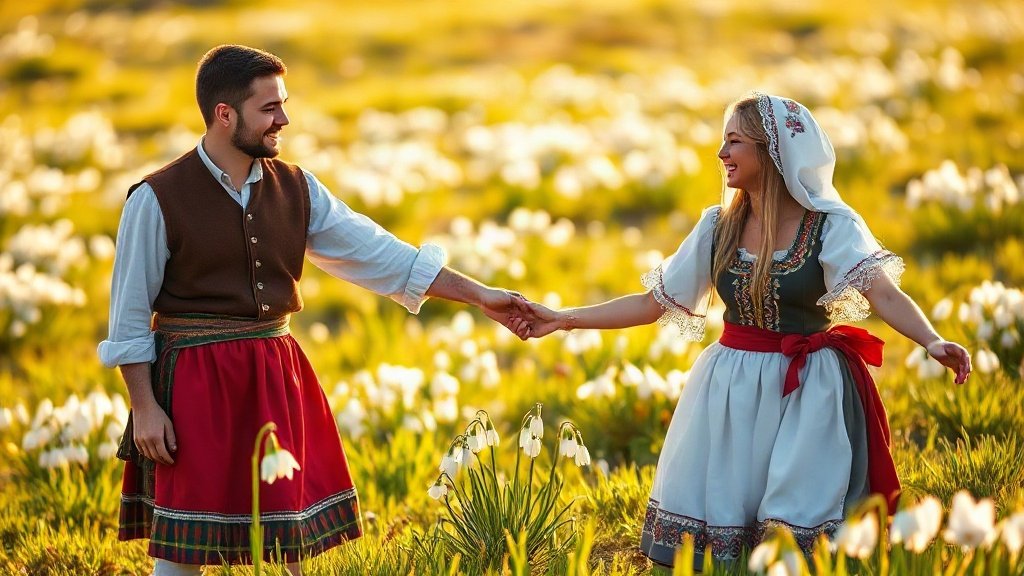
Illustration: AI-generated image
Before Valentine's Day swept across the globe, Romanians had their own celebration of love and the awakening of nature: Dragobete. Held on 24 February, this ancient festival marks the unofficial beginning of spring and honours youthful love, fertility and the pairing of birds. For anyone curious about authentic Romanian culture, Dragobete offers a charming glimpse into pre-Christian traditions that are still cherished today.
The Legend of Dragobete
Folklore presents Dragobete as a young, handsome god or a son of the old winter crone Baba Dochia, though in some tales he is simply a mortal man who became a symbol of love. He is sometimes called "the Romanian Cupid," but unlike the Roman god who shoots arrows, Dragobete is depicted as a gentle figure who helps young people find their true love. The date was chosen because it is around this time that birds begin to mate, seen as a sign of nature's rebirth and the right moment for human romance.
Traditional Customs
In villages across Romania, Dragobete was a day for young people to dress in their finest traditional clothes and gather on the edge of the village or in a clearing. The central activity was the search for early spring flowers—snowdrops, crocuses and the first violets—which were believed to have magical powers if picked on this day. Girls wore the flowers in their hair or pinned them to their blouses, while boys tried to charm them with songs and jokes.
A key ritual involved kissing over a bouquet of flowers. According to tradition, a kiss exchanged on Dragobete sealed a relationship for the whole year, and it was also a form of public engagement. In some regions, couples would run together through the fields, holding hands, which was thought to ensure their love would never break. Unmarried people who did not take part in the day's events were warned they would remain single for the rest of the year.
Superstitions and Beliefs
Dragobete was rich in weather lore and omens. If it rained, it was a sign of a good and fertile year. If birds could be heard singing, spring was near. Young women would sometimes listen to the direction from which the first bird called; it was believed their future husband would come from that same direction. Another custom involved women collecting snow and melting it to wash their faces, hoping for beauty and freshness throughout the year.
Modern Celebrations
Although Dragobete lost ground to imported Valentine's Day during the 20th century, recent years have seen a revival of interest in this native tradition. Many towns and villages host folk music performances, craft fairs and re-enactments of the old customs. For those who want to celebrate simply, the essence of Dragobete is easy to recreate: spend time outdoors in nature, pick the first spring flowers, wear something traditional if you have it, and share a meal or a dance with someone you care about.
Dragobete remains a beautiful reminder that love, like nature, is cyclical and deserves to be celebrated in its own season. Whether you are in Romania on 24 February or simply curious about its traditions, this is a holiday that welcomes everyone with an open heart.