Capra: Romania's New Year's Goat Dance and Its Playful Rituals
Discover Capra, the exuberant masked goat dance performed across Romania during the winter holidays, and the rich symbolism behind its leaps, bells and verses.
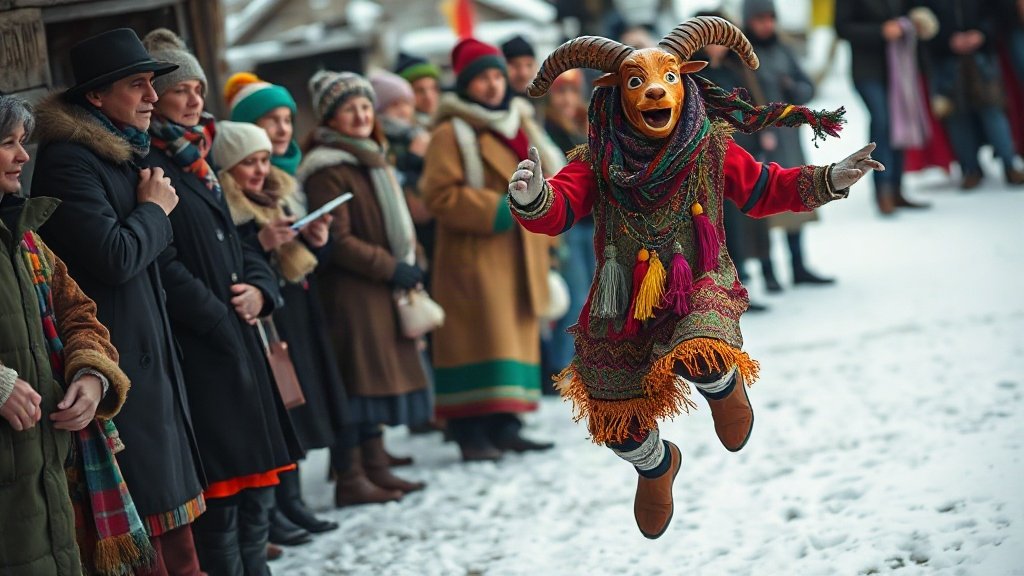
Illustration: AI-generated image
Across Romania, the turning of the year is marked not only by carols and well-wishing, but by a riot of masked dances. Among the most beloved is Capra, the goat dance — a playful, energetic performance that brings laughter, music and a touch of magic to the winter holidays.
The word capra simply means goat, and the tradition centres on a dancer who wears a carved wooden goat head. The head is usually painted, with a hinged lower jaw that clacks open and shut, and is attached to a colourful fabric body adorned with ribbons, tassels, mirrors and bells. The performer is often accompanied by a small troupe of masked characters: an old man, a gypsy, a doctor, a shepherd, and sometimes a bear or a horse. Together they move from house to house or perform in village squares, bringing good wishes for the new year.
Origins and Symbolism
Like many winter masked customs, Capra has deep roots in pre-Christian agricultural rituals. The goat was a symbol of fertility, vitality and the life-giving force of nature. Its dance, full of leaps, spins and sudden collapses, mirrors the cycle of death and rebirth: at the climax, the goat "dies," only to be revived by the doctor or the old man — a reminder that winter will pass and spring will come again. The clacking of the wooden jaws and the jingling of bells are thought to drive away evil spirits and awaken the sleeping earth.
How the Dance Unfolds
The Capra dance is improvised yet follows a familiar pattern. The goat prances and jerks, its jaws snapping in time to the music — often provided by a fiddle, accordion or panpipes. The onlookers sing or shout verses, many of them humorous and teasing, while the goat's companions mimic everyday life or act out comic scenes. The performance may last ten minutes or more, depending on the skill of the dancer, who must crouch beneath the heavy costume and control the goat head with precision.
Regional Variations
While the goat appears across much of Romania, each region adds its own flavour. In Moldova and Transylvania, the goat may be accompanied by a bear or a stork; in Muntenia, the troupe often includes a moș (old man) and a babă (old woman). The costume may be simple or elaborate, with dozens of ribbons in bright red, green and gold. In some villages, the goat is made from straw or reeds rather than wood, and the performance may extend from Christmas Eve to Epiphany.
Where to See Capra Today
Despite modern changes, Capra remains a living tradition. You can witness it in many villages during the last days of December and early January, especially in rural areas of Maramureș, Bucovina and northern Oltenia. Folklore festivals and Christmas markets in larger towns often stage performances, and many folk ensembles keep the custom alive for younger generations. If you are invited to watch, remember that the dance is both entertainment and ritual — applause, laughter and a respectful curiosity are always welcome.