Lacul Roșu: A Visitor's Guide to Romania's Red Lake
Discover Romania's Red Lake, a natural dam lake in the Eastern Carpathians, with its submerged forest, hiking trails and mountain scenery.
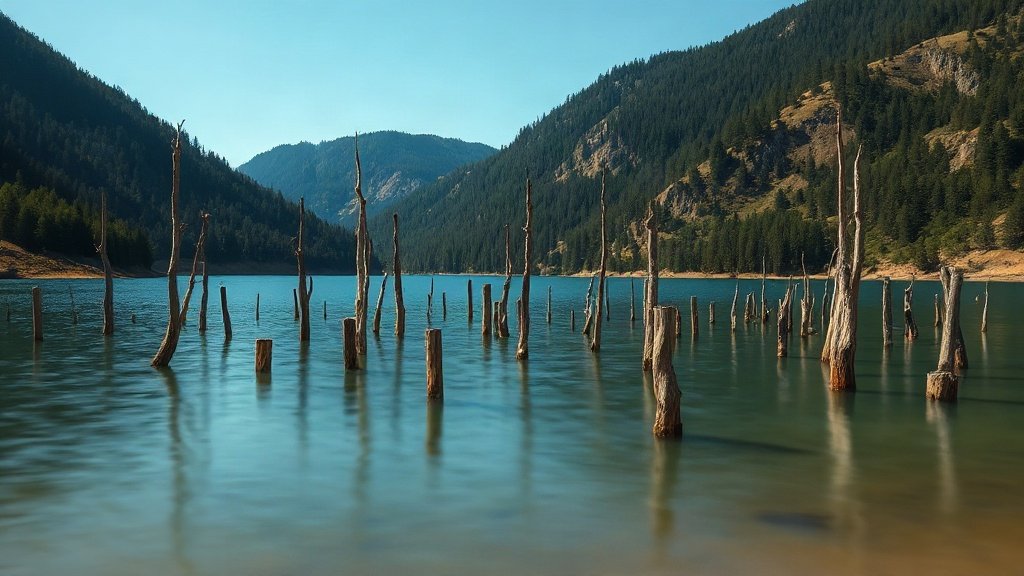
Illustration: AI-generated image
Hidden in the Eastern Carpathians, Lacul Roșu—Romania's Red Lake—is one of the country's most unusual natural wonders. Formed by a landslide in the 19th century, the lake is famous for the ghostly stumps of submerged trees that still rise from its waters, creating an eerie and beautiful landscape. Surrounded by steep forested slopes, it offers easy walks, boat rides and a gateway to the Bicaz Gorges. For travellers looking to escape the crowds of Transylvania's castles, this mountain lake is a refreshing stop.
A lake born from a landslide
Lacul Roșu sits at an altitude of about 980 metres, near the border of Harghita and Neamț counties. It was created in 1837 when a massive rockfall from the nearby Ghilcoș Mountain blocked the Bicaz River, flooding the valley behind it. The waters rose over a spruce forest, leaving many trunks still standing beneath the surface. The lake takes its name from the reddish iron oxides and clays washed down from the surrounding slopes, though the water is usually a clear green-blue.
Getting there and around
The lake lies along the DN12C road, which links Transylvania with Moldavia through the dramatic Bicaz Gorges. Most visitors arrive by car, as public transport is limited. From Gheorgheni, the drive takes about 30 minutes; from Piatra Neamț, it is roughly two hours. Parking is available near the lake's southern shore, where a short promenade leads to the main viewpoints. The area is compact and easy to explore on foot, with well-marked paths around the water's edge.
Things to do
For many, simply strolling along the lake shore is enough. The reflections of the submerged trees and surrounding peaks make it a photographer's delight, especially in autumn when the beech and spruce forests turn gold and rust. Rowing boats can be hired in summer to glide among the dead trunks, which some say resemble a sunken forest. A gentle walking trail circles the lake in about an hour, while more energetic hikers can climb to the top of Suhardul Mic for panoramic views of the lake and the Bicaz Gorges.
- Boat rides: Paddle among the ancient tree stumps and take in the mountain backdrop.
- Lakeside walk: A flat, easy path suitable for all ages, with benches and picnic spots.
- Hiking: Trails lead to the surrounding peaks, including the 1,360-metre Suhardul Mic.
- Photography: Early morning mist over the lake creates an unforgettable scene.
When to visit
Lacul Roșu is accessible year-round, but the experience changes with the seasons. Late spring and summer bring lush greenery and the warmest weather for boating and walking. Autumn is perhaps the most beautiful, when the hillsides blaze with colour. Winter transforms the area into a quiet, snowy landscape—the lake may freeze, and the surrounding roads can be icy, so a 4x4 and winter tyres are recommended. Weekdays are much quieter than summer weekends, when the lake draws many Romanian holidaymakers.
Where to stay and eat
The immediate lakeshore has a handful of guesthouses and small hotels, but many visitors stay in nearby Gheorgheni or in villages along the Bicaz Valley. Local restaurants serve hearty Romanian mountain food—think grilled trout, polenta with cheese, and wild mushroom stew. As with most of rural Romania, it's wise to carry some cash, as card payments are not always accepted in smaller establishments.
Practical tips
- Wear layers: Mountain weather can change quickly, even in summer.
- Bring insect repellent for the lakeside in warm months.
- Fuel up: There are few petrol stations in the immediate area, so fill your tank in Gheorgheni or Piatra Neamț.
- Combine with the Bicaz Gorges: The drive through the gorges is one of Romania's most spectacular, and the lake is the perfect turnaround point.
Whether you pause for an hour on a road trip or stay for a few days of hiking, Lacul Roșu offers a peaceful, otherworldly corner of the Carpathians. Its story—a forest drowned by nature's force—makes it a memorable stop on any Romanian itinerary.