Bucegi Plateau: A Guide to Romania's Sphinx and Babele
Discover the otherworldly rock formations of the Bucegi Mountains, including the Sphinx and Babele, and learn how to reach this high-altitude plateau.
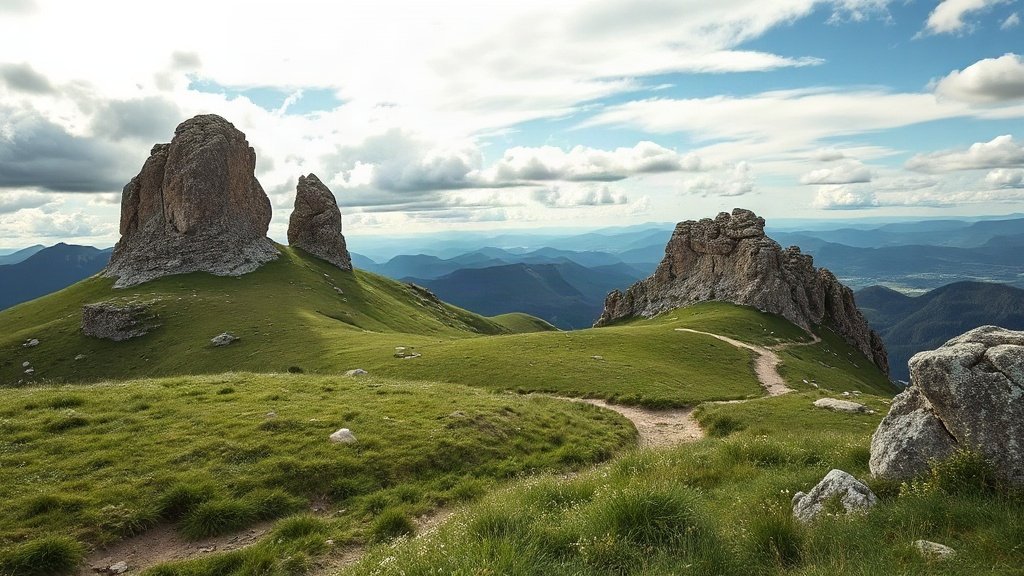
Illustration: AI-generated image
The Bucegi Mountains rise sharply from the Prahova Valley, forming a dramatic eastern edge of the Southern Carpathians. Their high plateau, perched above 2,000 metres, is home to some of Romania's most curious natural landmarks: wind-sculpted rocks that have fuelled local legends and drawn visitors for generations.
The Sphinx and Babele
The Sphinx is a mushroom-shaped rock formation whose profile, when viewed from a certain angle, resembles a human head. Standing about eight metres tall, it has become one of Romania's most photographed natural wonders. Nearby, the Babele (meaning "old women") are a cluster of rounded rock towers that look like silent figures gathered on the plateau.
Geologists explain these shapes as the result of millennia of erosion by wind, rain, and frost. The rocks are composed of conglomerate and sandstone, layers of which have worn away at different rates. Local folklore, however, offers more mystical interpretations, linking the Sphinx to ancient energies or lost civilisations. Regardless of the story you prefer, the scenery is undeniably striking.
Getting There
The easiest way to reach the plateau is by cable car from the mountain resort of Bușteni. The journey takes about 15 minutes and climbs over 1,000 metres, offering sweeping views of the Prahova Valley. From the top station, the Sphinx and Babele are a short walk along a marked path.
For those who prefer to hike, several trails lead up from Bușteni, Sinaia, or the high mountain road near Piatra Arsă. The most direct route from Bușteni takes around three to four hours and follows a steep but well-defined path through forest and alpine meadows. The hike is demanding but rewarding, with plenty of places to rest and take in the views.
Exploring the Plateau
Beyond the famous rocks, the Bucegi Plateau is a high, gently undulating grassland dotted with patches of juniper and mountain pine. It is a popular area for easy walking, as the terrain is relatively flat once you are on top. On clear days, the views stretch across the Carpathian ridges to the south and the Transylvanian hills to the north.
Other notable sights include the Caraiman Cross, a metal monument erected on a nearby peak to honour fallen soldiers of the First World War, and Omu Peak, the highest point of the Bucegi at 2,505 metres. Both are reachable on foot from the plateau, and the trail to Omu Peak is a favourite among day hikers.
Best Time to Visit
Summer and early autumn are the most pleasant seasons for exploring the Bucegi Plateau. From late June to September, the alpine meadows are green, wildflowers bloom, and temperatures are mild. On a clear day, visibility can be extraordinary, allowing you to see across vast stretches of the Carpathians.
Winter brings deep snow and harsh conditions, making the plateau suitable only for experienced mountaineers with proper equipment. The cable car may run year-round, but weather can cause closures, so it is wise to check conditions before setting out.
Practical Tips
- Weather on the plateau can change quickly, even in summer. Bring layers and a waterproof jacket.
- The cable car operates seasonally and can have long queues on weekends and public holidays.
- There is a mountain hut near the top for refreshments, but it is wise to carry water and snacks.
- Stick to marked trails to protect the fragile alpine vegetation and avoid getting lost in fog.
- If you hike from Bușteni, start early in the morning to allow plenty of time for the ascent and descent.