The Țambal: Romania's Hammered Dulcimer and Its Role in Folk Music
Discover the țambal, a resonant hammered dulcimer central to Romanian folk ensembles, and learn how its bright, percussive sound shapes the country's traditional music.
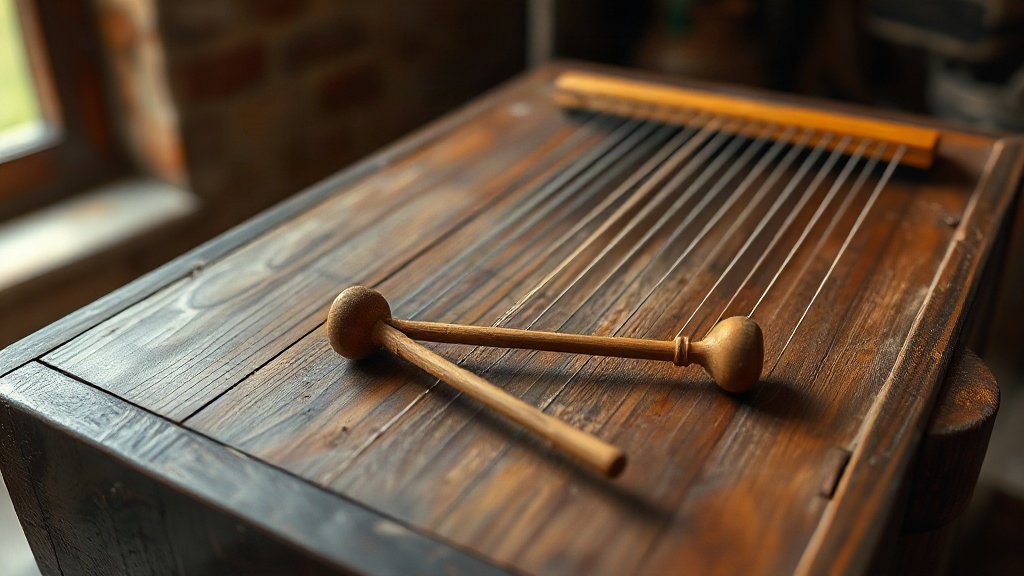
Illustration: AI-generated image
Romania's rich folk music tradition is built on a foundation of distinctive instruments, each contributing a unique voice to the lively taraf ensembles heard at weddings, festivals, and village celebrations. Among these, the țambal stands out for its shimmering, percussive resonance—a sound that dances between melody and rhythm, captivating listeners with its cascading notes.
What is the țambal?
The țambal is a type of hammered dulcimer, a trapezoidal wooden box strung with numerous steel strings stretched over bridges. The musician plays it by striking the strings with two small wooden hammers, often wrapped in cotton or leather to soften the attack. This produces a bright, bell-like tone that can be both delicate and intensely rhythmic. The instrument is typically placed on a stand or the player's lap, allowing for rapid, intricate passages.
A history of strings and hammers
The hammered dulcimer has ancient roots, with similar instruments appearing across the Middle East, Asia, and Europe. The țambal arrived in Romanian lands through Ottoman influence, likely during the 18th or 19th century, and was quickly adopted by lăutari—the professional folk musicians. It evolved into a larger, fully chromatic instrument, capable of playing complex melodies and harmonies, and became a staple of both rural and urban folk ensembles.
Playing the instrument
Mastering the țambal requires remarkable dexterity. The player uses a combination of wrist movements to bounce the hammers across the strings, achieving rapid tremolos and glissandos. Damping techniques control sustain, while precise striking produces clear, articulated notes. The instrument's range allows for both high, sparkling passages and deep, resonant bass lines. In traditional settings, the țambal often follows the melodic line of the violin or plays rhythmic accompaniments that drive the dance.
The țambal in folk ensembles
In a taraf, the țambal occupies a central role, bridging melody and rhythm. It provides harmonic support, fills in between phrases, and often takes virtuosic solos. Its percussive nature makes it ideal for the driving rhythms of the hora and sârbă, while its lyrical potential shines in doinas and love songs. The instrument also features prominently in the urban lăutărească music of Bucharest and other cities, where it adds a distinctive sparkle to café and restaurant performances.
Where to hear it today
The țambal continues to thrive in contemporary Romanian folk music. It is a fixture at traditional weddings, festivals, and cultural events, and has been embraced by modern fusion groups exploring new sounds. For travellers, hearing a skilled țambal player live is an unforgettable experience—a cascade of notes that seems to pour from the instrument like sunlight on water. Whether in a village celebration or a concert hall, the țambal remains a testament to Romania's vibrant musical heritage.