Învârtita: Romania's Spirited Couple Dance of Whirling Joy
Discover Învârtita, the traditional Romanian couple dance from Transylvania, known for its rapid spins, precise footwork and central role at weddings and village celebrations.
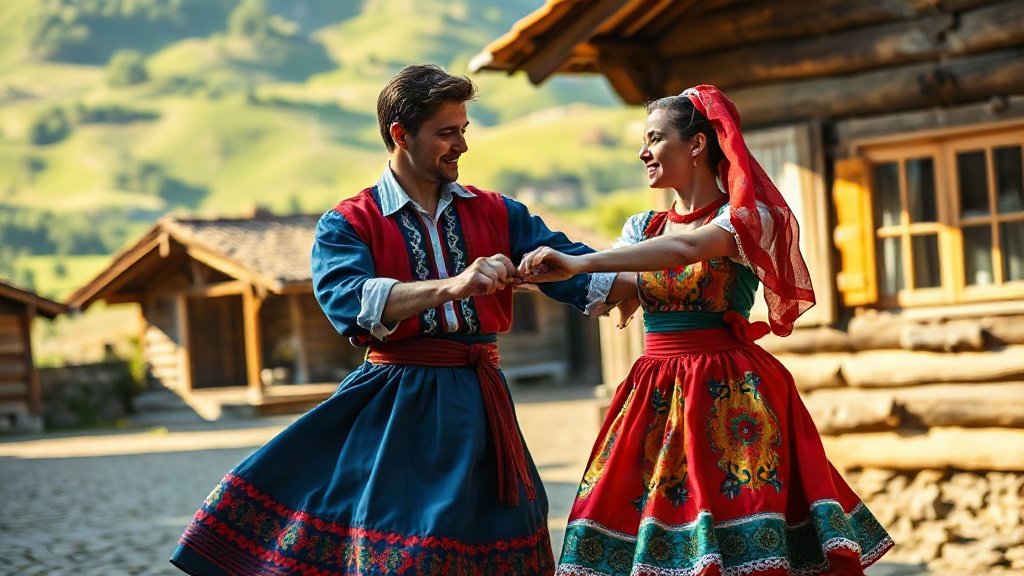
Illustration: AI-generated image
Învârtita is a lively couple dance deeply rooted in the folk traditions of Transylvania, particularly in regions like Mureș, Cluj and Bistrița-Năsăud. Its name comes from the Romanian verb a învârti, meaning “to spin” or “to turn,” and the dance lives up to that name with its signature whirling movements and quick, precise footwork. Often performed at weddings, Sunday dances and village celebrations, Învârtita is both a display of skill and a joyful expression of community.
A Dance of Courtship and Skill
Traditionally, Învârtita is danced in pairs, with the man leading and the woman following. The couple holds hands or links arms, and the dance consists of a series of fast spinning turns interspersed with stamping steps and rhythmic pauses. The man often guides the woman in tight circles, sometimes lifting her slightly off the ground, while the woman responds with graceful, controlled movements. This interplay requires strength, balance and a good sense of rhythm, making it a favourite for showcasing agility and partnership.
In many villages, Învârtita was a way for young people to court and demonstrate their vitality. Older generations recall that the dance was a highlight of the hora gatherings, where the music would suddenly shift to a faster tempo, and couples would break away from the circle to spin together. Today, Învârtita remains a staple of folk ensembles and cultural festivals, preserving its energetic charm.
The Music Behind the Spins
Învârtita is usually accompanied by a taraf—a small folk band—featuring instruments like the violin, viola, double bass and sometimes the cimbalom or accordion. The music is in a lively 2/4 or 6/8 time, with driving rhythms that build in intensity. The melody often starts moderately and accelerates, pushing the dancers to spin faster and faster. The violin leads with crisp, ornamented phrases, while the double bass provides a steady, bouncing pulse. This musical dynamism is essential to the dance, as dancers synchronise their turns with the beat and the melodic cues.
Regional Variations and Context
While Învârtita is most strongly associated with Transylvania, similar spinning couple dances appear across Romania under different names, such as învârtita de pe Mureș or învârtita de la Câmpia Transilvaniei. Each region adds its own flavour: some versions emphasise high kicks, while others focus on continuous rotation. The dance is often performed in folk costume, with women wearing layered skirts that flare beautifully during the spins, adding to the visual spectacle. Men’s costumes, with their fitted trousers and boots, allow for sharp, precise footwork.
Beyond entertainment, Învârtita carries a sense of belonging and continuity. Learning the dance is part of growing up in many rural communities, passed down from parents to children. For visitors to Romania, witnessing an authentic Învârtita at a village festival or a folk performance offers a vibrant window into the country's living heritage—a reminder that tradition is not static but spins forward with joy and energy.