Paparudele: Romania's Rain-Making Ritual of Song and Dance
Discover Paparudele, Romania's ancient rain-summoning ritual where dancers dressed in leaves sing for clouds and are doused with water.
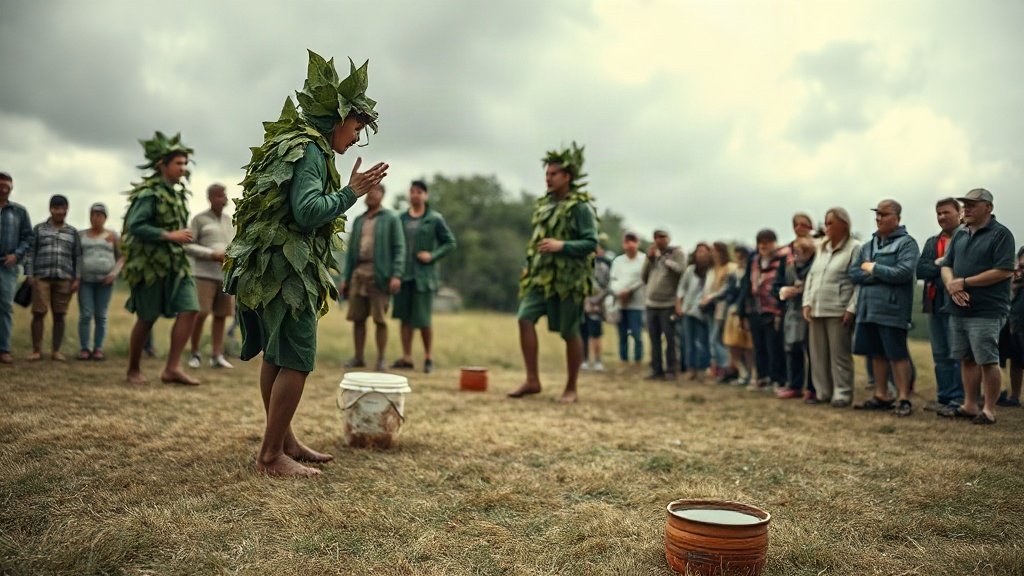
Illustration: AI-generated image
When the skies stay cloudless and the fields begin to crack, some Romanian villages still call on an ancient ally: the paparude. Dressed head to toe in fresh green leaves, these dancers take to the streets to sing for rain — and to get thoroughly soaked in the process.
A Ritual Born of Dry Spells
Paparudele (also known as perperuna in some regions) is a rain-making ritual with roots that reach back long before Christianity arrived in the Carpathians. The custom has parallels across the Balkans, from Bulgaria to Serbia, but in Romania it developed its own distinct flavour, especially in the southern plains of Muntenia and Oltenia, where summer droughts hit hardest.
Traditionally, the ritual was performed by young girls or by women who had learned the special songs and movements from their elders. They would go from house to house, dancing and singing a specific incantation, while householders poured water over their heads. The logic was simple and beautifully direct: if you want rain, imitate it.
The Leafy Costume
The paparude costume is a masterpiece of ephemeral fashion. Skirts, headdresses and sometimes entire body coverings were woven from fresh leaves — burdock, elder, vine or any large, cool leaf that could hold water. The greenery served both as a symbol of vegetation thirsting for rain and as a practical shield against the summer sun.
In some villages, the dancers also wore wreaths of flowers and carried branches, adding to the impression of walking forests come to plead with the sky.
The Song and the Dance
The song of the paparude is short, repetitive and hypnotic. Though variations exist from village to village, the core plea remains the same: “Paparudă, rudă, / Vino de ne udă” — “Paparuda, come and wet us.” The dancers stomp and spin in a simple circle, their leaf skirts rustling like wind through trees, while the householder pours water from a bucket or a jug over their heads.
The water is not just symbolic; it is the whole point. The more the dancers get drenched, the more rain is expected to follow. After the ritual, the wet leaves were sometimes left in the garden or field, a final offering to the earth.
Where to See It Today
Like many folk customs, paparudele has faded from everyday practice. But it has not disappeared. You can still witness the ritual at folklore festivals across Romania, where troupes recreate the dance with authentic costumes and songs. Some villages in Dolj, Olt and Teleorman counties have revived the tradition as a way to celebrate their heritage, often performing it during local “zilele comunei” (village days) or in August, when the risk of drought is highest.
For visitors, seeing paparudele is a rare chance to connect with a worldview that sees the natural world not as a machine, but as a conversation. It is a reminder that, for much of human history, the most practical response to a dry sky was a song, a dance and a bucket of water.